
Original section → resulting record
Property report processing
Kesit
Extracts structured data from valuation reports using text and visual processing. Normalizes fields and prepares results for review and transfer to enterprise systems.
- Information foundation
- Digital or scanned valuation report
- Operational outcome
- Validated, structured report data
- Human responsibility
- Model disagreements and result review
Inside the application
Application workflow
Selected use cases, source information and operational outputs.
Processing that fits the page
Digital pages use text extraction; scans, drawings and handwritten fields use visual processing.
KesitScenario / 01
Interface conceptSchematic example
Report reading
Text + image
Structured information
Digital page
Scanned page
Table field
Shared report schema
Decision boundary
Model disagreements and result review
- Digital or scanned valuation report
OutputValidated, structured report data
Checks for Turkish documents
Dates, amounts and percentages are normalized.
KesitScenario / 02
Interface conceptSchematic example
Field validation
Information fieldControl
Date formatSource format
Amount and percentageShared representation
Format checkTransformation rule
Model disagreementHuman review
Decision boundary
Model disagreements and result review
- Digital or scanned valuation report
OutputValidated, structured report data
Continuity for long-running jobs
Document, page and model operations are recorded.
KesitScenario / 03
Interface conceptSchematic example
Processing continuity
Dependent steps
- 1DocumentSource and scope
- 2PageProcessing context
- 3Model operationReview point
- 4JSON outputNext operation
Interruption and retry paths are defined separately.
Decision boundary
Model disagreements and result review
- Digital or scanned valuation report
OutputValidated, structured report data
Application approach
Scope and operating approach.
The scope, operating approach and boundaries of this work.
01Processing that fits the page
Digital pages use text extraction; scans, drawings and handwritten fields use visual processing. Results are combined in a shared report schema.
02Checks for Turkish documents
Dates, amounts and percentages are normalized. Identity, tax and bank account fields receive format checks; model disagreements follow an additional verification path.
03Continuity for long-running jobs
Document, page and model operations are recorded. Interrupted jobs can resume without repeating completed steps. Structured JSON supports review and integration with enterprise systems.
In everyday work
Turning a long report into usable fields
A valuation report may combine text, scanned pages, tables and drawings. Kesit chooses processing paths by page type rather than applying one reading method to the whole document.
Property report processing
Fictional sample dataTurning a long report into usable fields
01Report pages
Sample source fileReport pages
Page typeScanned page
Source date09/09/2026
Normalized date2026-09-09
02Field extraction
Original section → resulting record
Original section → resulting record
03Validation and output
Illustrative review stateModel disagreements and result review
Dates, amounts and percentages are standardized. Format checks and model disagreements are reviewed separately; a valid format alone does not prove a document’s claim.
OutputValidated, structured report data
Report pages
Processing that fits the page
This component shows incoming information together with its identity and provenance. Digital text extraction and visual reading are selected for the document. Results from different pages are assembled into one report schema.
Field extraction
Checks for Turkish documents
This component explains how records are reviewed rather than displaying a result in isolation. Dates, amounts and percentages are standardized. Format checks and model disagreements are reviewed separately; a valid format alone does not prove a document’s claim.
Validation and output
Continuity for long-running jobs
This component distinguishes the user’s decision from the next work record. Execution records support resuming long-running jobs. Reviewable JSON is prepared for business systems; extraction does not replace the valuer’s professional judgment.
The whole operation
Information, decisions and outcomes stay connected.
These distinctions show the information the application receives, where it needs the user and what it leaves for the next operation.
- Starting information
- Digital or scanned valuation report
- Human decision
- Model disagreements and result review
- Resulting structure
- Validated, structured report data
How do we assess its impact?
These are evaluation dimensions, not measured performance results. Comparisons use the same task types, data scope and human-review conditions.
- Field correction needs
- Page processing errors
- Completed report coverage
Related work
Related applications.
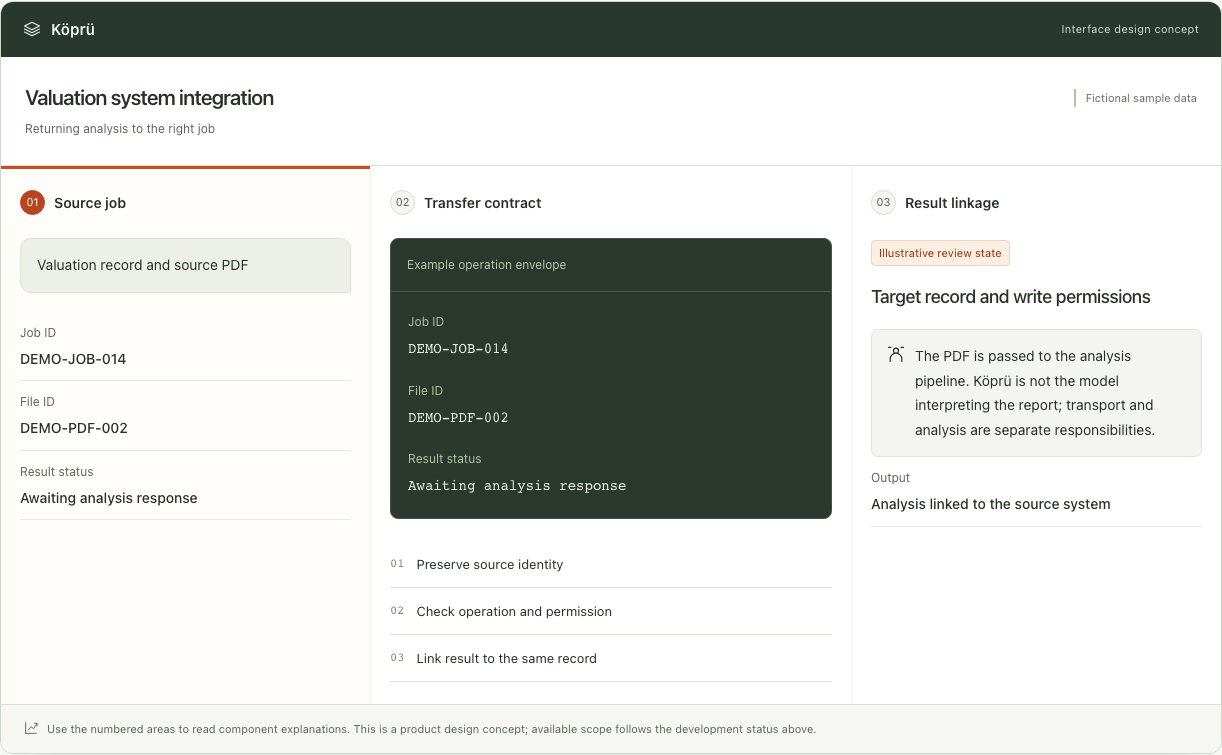 Interface conceptIntegration component
Valuation system integration
Köprü
Connects valuation applications to document analysis. Retrieves the source report and returns structured results, processing status and errors to the matching business record.
Explore the application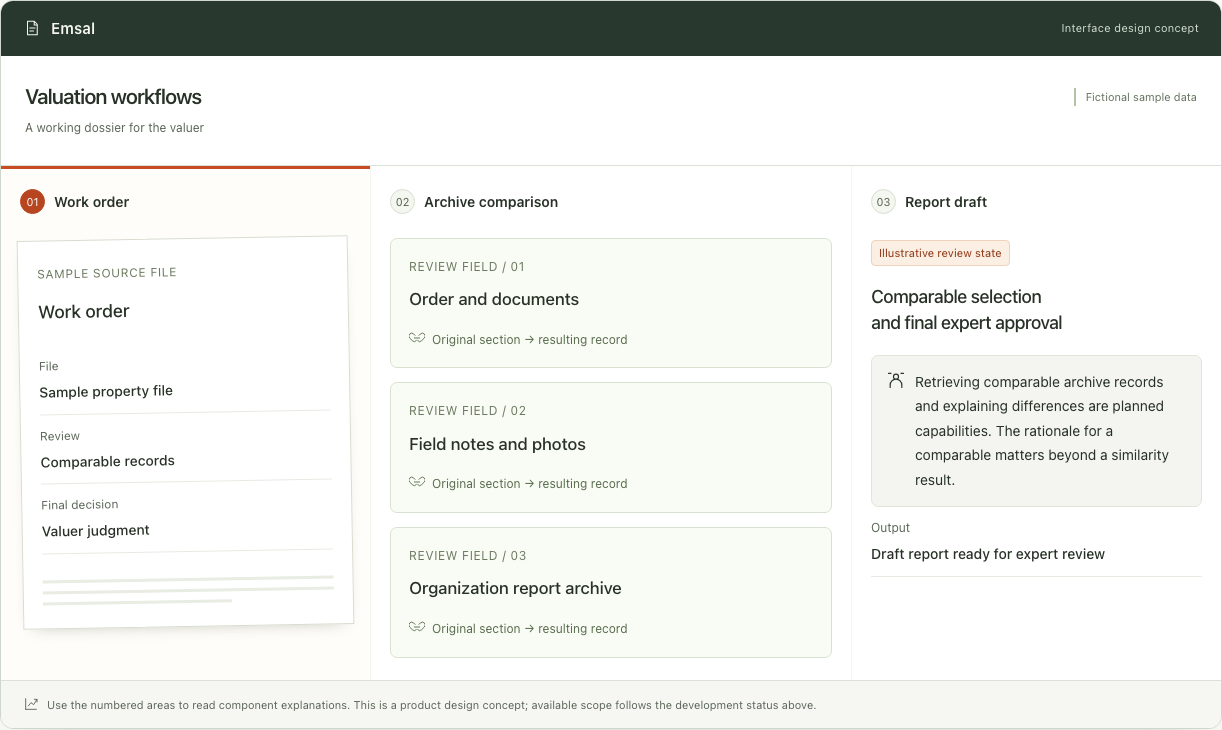 Interface conceptPlanning
Valuation workflows
Emsal
A planned valuation-assistance workspace for document collection, archive-based comparisons and report drafting. Valuation and final report decisions remain with the expert.
Explore the application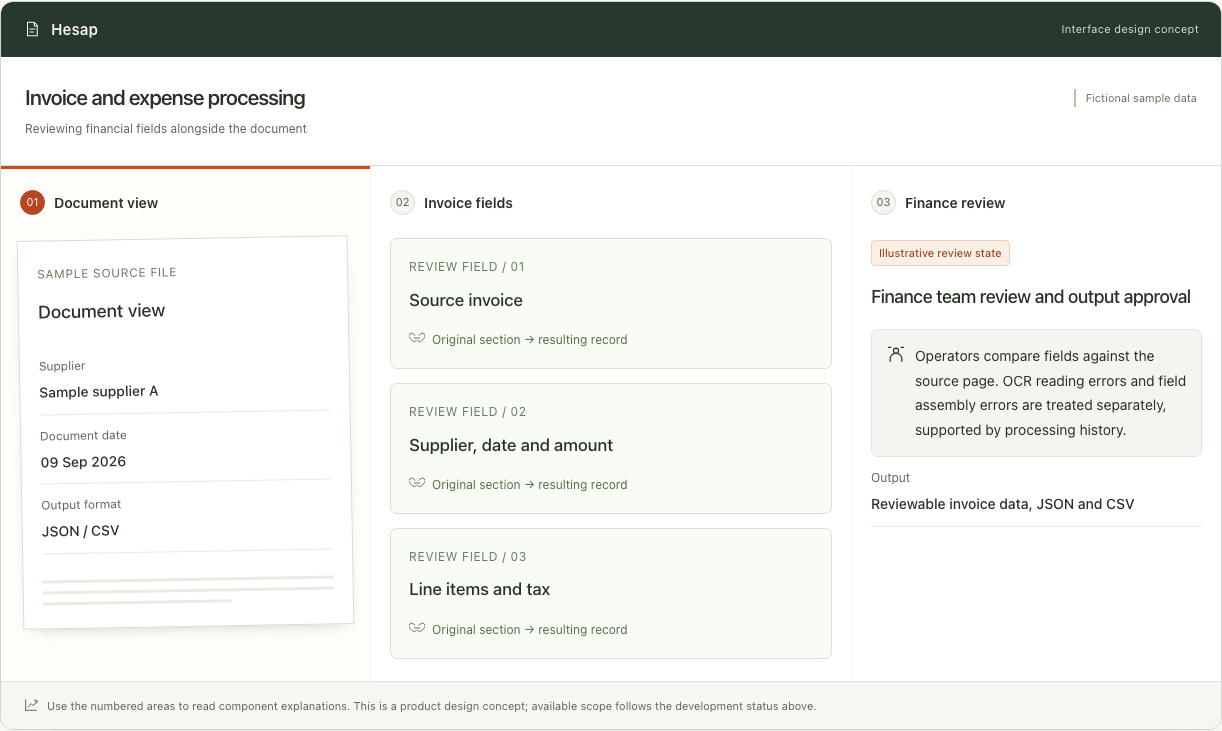 Interface conceptApplication development
Invoice and expense processing
Hesap
Extracts fields from invoices and expense attachments. Operators review the source document and extracted data together before exporting approved results.
Explore the applicationWork with us
Discuss your project with us.
Let’s assess your operations, data landscape and priorities together.