Connects certificates, organizations, products and shipments in a shared data environment. Combines document storage, relationship views, search and review.
Selected use cases, source information and operational outputs.
Read a certificate in context
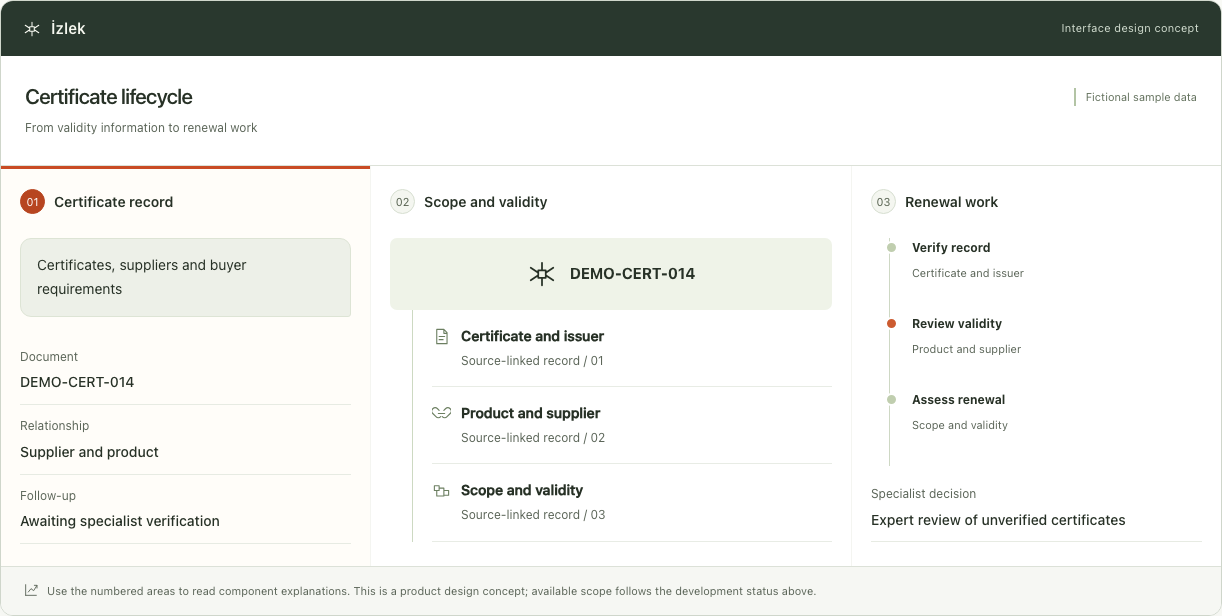
Transaction certificates connect to organizations, shipments, products and scope documents.
SicilScenario / 01
Interface conceptSchematic example
Certificate relationships
Certificate
Organization
Product and scope
Shipment
Connections represent shared sources or relationships, not sequential processing steps.
Decision boundary
Conflicting and incomplete record review
Certificate, scope, audit and shipment records
OutputConnected document archive and review workspace
Files, records and search together
Original files, structured fields, relationships and text search use distinct storage layers.
SicilScenario / 02
Interface conceptSchematic example
Shared archive
Collection
Raw file
Standardized field
Record relationship
Text search
Decision boundary
Conflicting and incomplete record review
Certificate, scope, audit and shipment records
OutputConnected document archive and review workspace
From ingestion to review
Processing status remains visible.
SicilScenario / 03
Interface conceptSchematic example
Ingestion and review
Processing stepTracked context
1Source systemSource
2Data processingOperation
3Relationship checkReview
4Review workspaceOutput
Decision boundary
Conflicting and incomplete record review
Certificate, scope, audit and shipment records
OutputConnected document archive and review workspace
Application approach
Scope and operating approach.
The scope, operating approach and boundaries of this work.
01
Read a certificate in context
+
Transaction certificates connect to organizations, shipments, products and scope documents. Sicil stores these relationships as records while preserving the business object behind each document.
02
Files, records and search together
+
Original files, structured fields, relationships and text search use distinct storage layers. Certificate and organization interfaces provide access to them.
03
From ingestion to review
+
Processing status remains visible. The first working version covers ingestion, search, relationships and review. Model and search providers require deployment-specific configuration.
In everyday work
From document storage to connected information
Certificates gain meaning through organizations, products, shipments and scope records. Sicil brings these links into an environment that supports retrieval and joint review.
Sicil / Working modelIllustrative use · no real customer data
Users can move from a certificate to its organization or shipment. Text search and record relationships answer different questions about the same archive.
OutputConnected document archive and review workspace
Document archive
Read a certificate in context
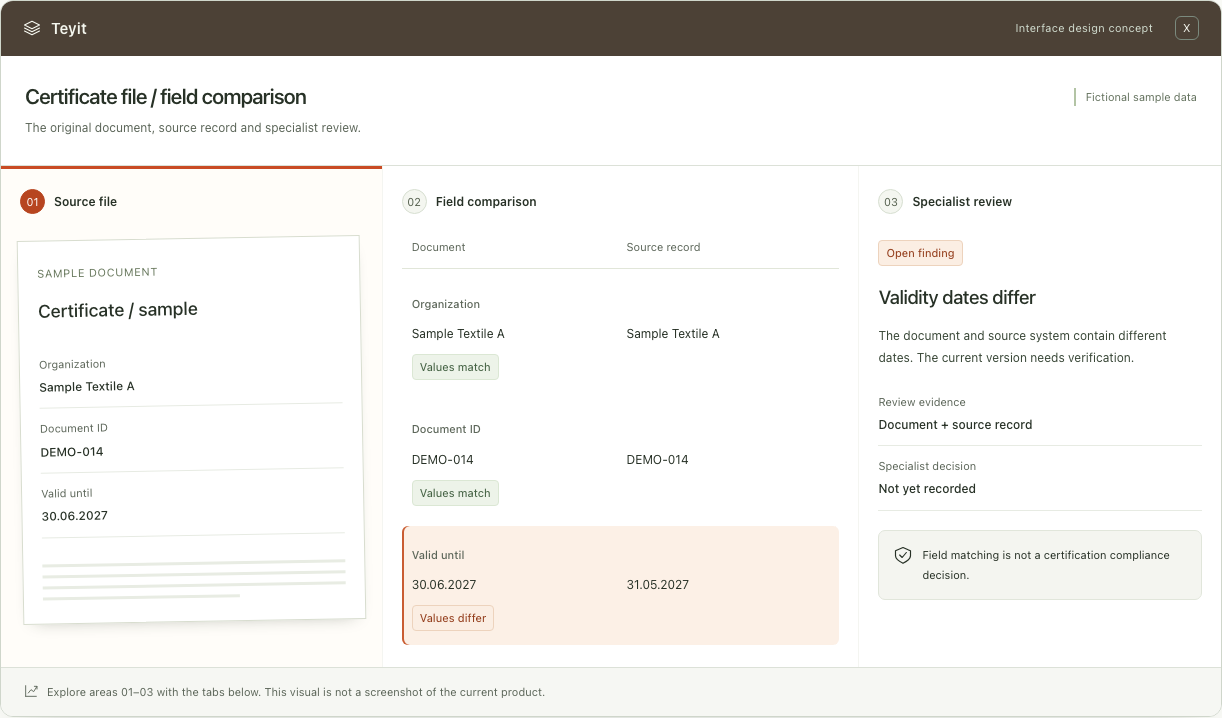
This component shows incoming information together with its identity and provenance. Source files and structured records use separate storage layers. Ingestion status stays visible so unprocessed records are not presented as completed data.
Record relationships
Files, records and search together
This component explains how records are reviewed rather than displaying a result in isolation. Users can move from a certificate to its organization or shipment. Text search and record relationships answer different questions about the same archive.
Review context
From ingestion to review
This component distinguishes the user’s decision from the next work record. The initial working scope includes ingestion, search, relationships and review. Resolving incomplete or conflicting records remains part of data preparation.
The whole operation
Information, decisions and outcomes stay connected.
These distinctions show the information the application receives, where it needs the user and what it leaves for the next operation.
Starting information
Certificate, scope, audit and shipment records
Human decision
Conflicting and incomplete record review
Resulting structure
Connected document archive and review workspace
How do we assess its impact?
These are evaluation dimensions, not measured performance results. Comparisons use the same task types, data scope and human-review conditions.

 Interface conceptCustom application