
Establish source and permitted use.
Model adaptation
Ayar
Research and data preparation for model evaluation and adaptation. Connects examples to source rules, expected tool behavior and organization-specific tasks.
- Information foundation
- Approved rules and development examples
- Operational outcome
- Task- and source-linked training data
- Human responsibility
- Data selection and evaluation decisions
Inside the application
Application workflow
Selected use cases, source information and operational outputs.
Examples with known sources
Each example relates to a target tool, source rule and expected behavior.
AyarScenario / 01
Interface conceptResearch / conceptual
Training example
Structure definitionDATASET
1inputSource rule
2contextTask input
3reviewExpected tool
4outputExpected behavior
Conceptual field mapping, not executable code.
Decision boundary
Data selection and evaluation decisions
- Approved rules and development examples
OutputTask- and source-linked training data
Planned expansion
Examples from knowledge, code, sessions and change history, along with additional training methods and adaptation runs, are part of the research plan.
AyarScenario / 02
Interface conceptResearch / conceptual
Research scope
Knowledge vault
Code examplesDefined dependency
Session historyDefined dependency
Adaptation planDefined dependency
Processing and control structure
Decision boundary
Data selection and evaluation decisions
- Approved rules and development examples
OutputTask- and source-linked training data
Evaluate change on the same tasks
The aim is to assess tool selection and BPM rule adherence alongside training results.
AyarScenario / 03
Interface conceptResearch / conceptual
Model evaluation
Dimensions to evaluate
No result data01Reference task
02Tool choice
03Rule compliance
04Error for review
Shows comparison criteria. Numerical charts require verified data and a defined method.
Decision boundary
Data selection and evaluation decisions
- Approved rules and development examples
OutputTask- and source-linked training data
Application approach
Scope and operating approach.
The scope, operating approach and boundaries of this work.
01Examples with known sources
Each example relates to a target tool, source rule and expected behavior. The initial working scope prepares supervised training examples from prompts.
02Planned expansion
Examples from knowledge, code, sessions and change history, along with additional training methods and adaptation runs, are part of the research plan.
03Evaluate change on the same tasks
The aim is to assess tool selection and BPM rule adherence alongside training results. A training and evaluation plan does not imply a completed production model.
Research scope: application behavior and business outcomes require pilot validation.
In everyday work
Reliable examples before adaptation
Evaluating better BPM behavior requires clear expectations about the rule and tool a model should use. Ayar begins with traceable training examples.
Model adaptation
Fictional sample dataReliable examples before adaptation
01Example source
Approved rules and development examples
Source ruleBPM development rule
Expected behaviorCorrect tool and field selection
StatusData preparation and research
02Dataset preparation
Keep the same task and scope.
Do not claim success without results.
03Evaluation plan
Illustrative review stateData selection and evaluation decisions
Dataset expansion and adaptation runs are separate research stages. Planned examples from the knowledge vault, code and session history are not confused with the initial scope.
OutputTask- and source-linked training data
Example source
Examples with known sources
This component shows incoming information together with its identity and provenance. Supervised examples are prepared from approved prompt sources. Each connects to a source rule, target tool and expected behavior.
Dataset preparation
Planned expansion
This component explains how records are reviewed rather than displaying a result in isolation. Dataset expansion and adaptation runs are separate research stages. Planned examples from the knowledge vault, code and session history are not confused with the initial scope.
Evaluation plan
Evaluate change on the same tasks
This component distinguishes the user’s decision from the next work record. Evaluation should consider task outcomes and BPM rule adherence, not training loss alone. A research plan is not presented as a finished production model.
The whole operation
Information, decisions and outcomes stay connected.
These distinctions show the information the application receives, where it needs the user and what it leaves for the next operation.
- Starting information
- Approved rules and development examples
- Human decision
- Data selection and evaluation decisions
- Resulting structure
- Task- and source-linked training data
How do we assess its impact?
These are evaluation dimensions, not measured performance results. Comparisons use the same task types, data scope and human-review conditions.
- Example traceability
- Task-level rule adherence
- Training and evaluation separation
Related work
Related applications.
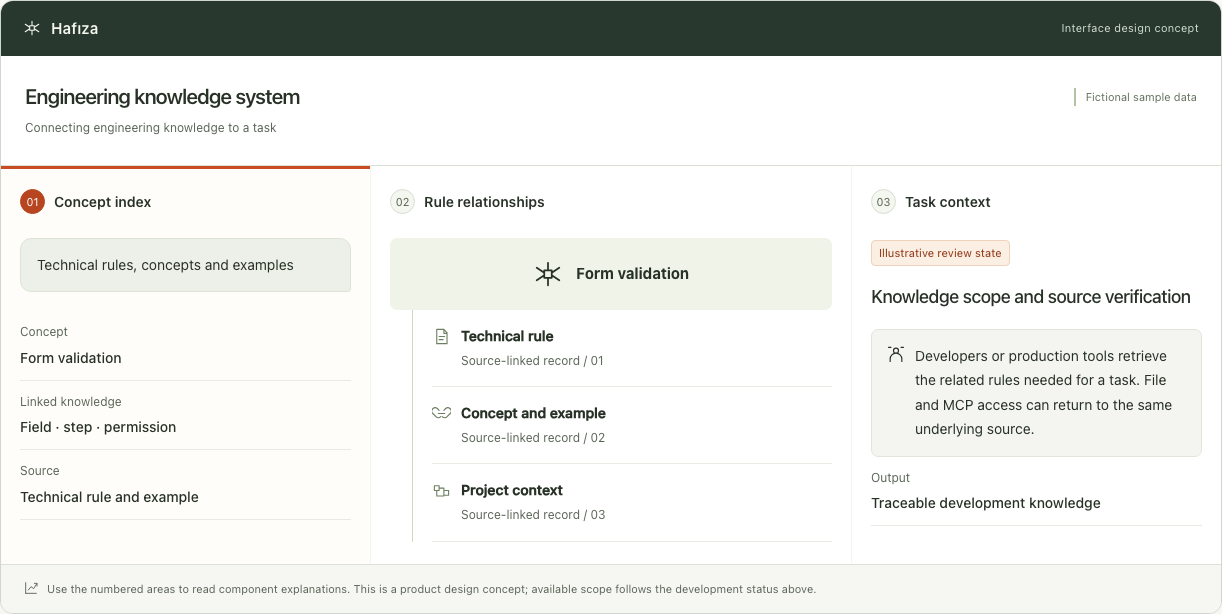 Interface conceptEngineering infrastructure
Engineering knowledge system
Hafıza
Organizes BPM engineering rules, concepts and source relationships in a knowledge repository. Development tasks can retrieve relevant context through files and MCP tools.
Explore the application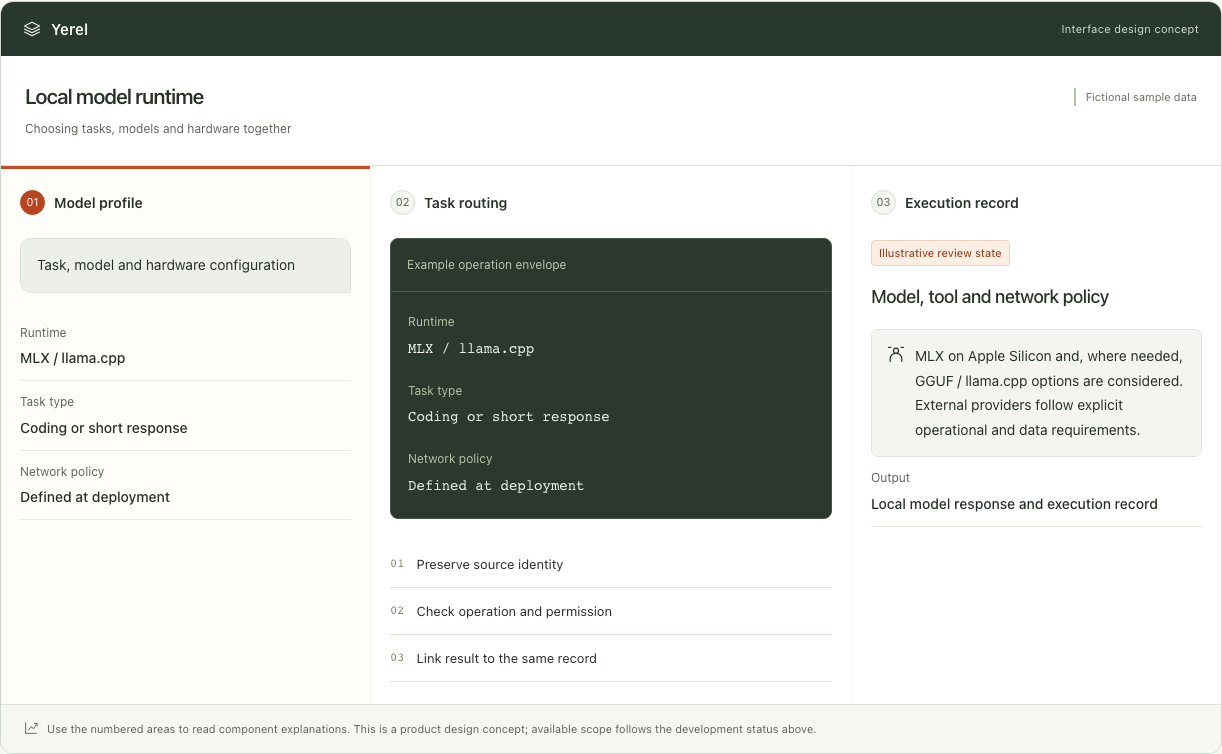 Interface conceptEngineering infrastructure
Local model runtime
Yerel
Local model serving and task-routing infrastructure. Supports different model services for coding and fast-response tasks, with operational and behavior checks.
Explore the application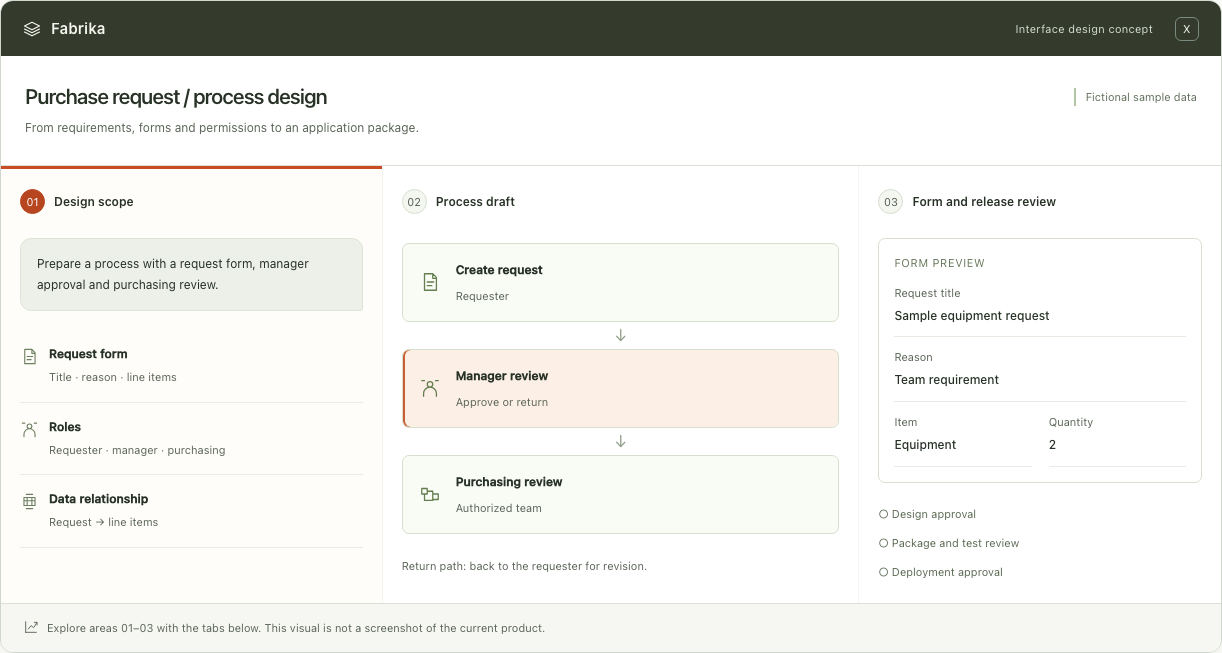 Interface conceptProduct development
Process and software development
Fabrika
Prepares forms, processes, permissions and data structures from business requirements. Engineering teams retain control over design approval and deployment.
Explore the applicationWork with us
Discuss your project with us.
Let’s assess your operations, data landscape and priorities together.