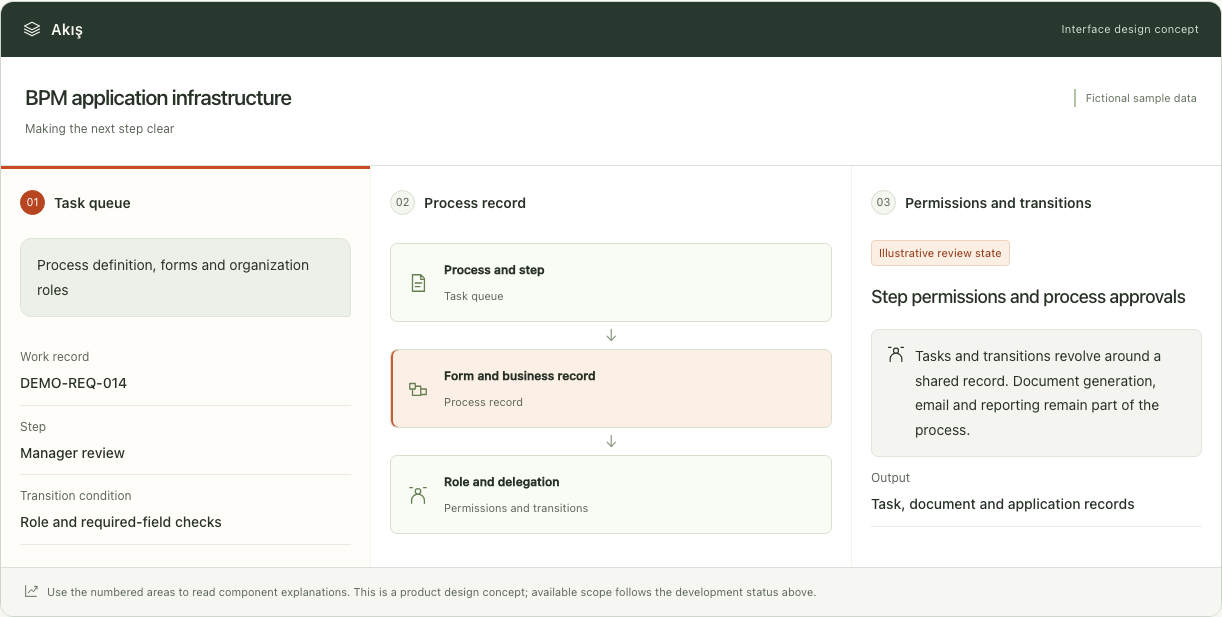
Prepares forms, processes, permissions and data structures from business requirements. Engineering teams retain control over design approval and deployment.
Business requirements and the existing application
Operational outcome
Validated BPM change package
Human responsibility
Design approval and release approval
Inside the application
Application workflow
Selected use cases, source information and operational outputs.
From request to impact map
Considers a request alongside existing forms, processes, roles and data relationships. Plans and dependencies show which parts the change affects.
FabrikaScenario / 01
Interface conceptSchematic example
Process blueprint
Business brief
Form and fieldDefined dependency
Role and stepDefined dependency
Data relationshipDefined dependency
Processing and control structure
Decision boundary
Design approval and release approval
Business request
Existing application
Business rules
OutputReviewable scope and dependencies
Controlled software generation
Prepares code and data changes from an approved design. Generation work, checks and findings stay within the same change scope for engineering review.
FabrikaScenario / 02
Interface conceptSchematic example
Change package
Structure definitionBPM
1inputProcess definition
2contextSchema validation
3reviewGenerated component
4outputTest evidence
Conceptual field mapping, not executable code.
Decision boundary
Design approval and release approval
Approved design
Generation agents
Check results
OutputReviewable change package
Continuity from revision to release
Revisions, file differences and evidence remain in one work history. Design and deployment decisions are separate, with release permissions and rollback context reviewed explicitly.
FabrikaScenario / 03
Interface conceptSchematic example
Two separate decisions
Initial assessment
Design review
Scope approval
Decision
Governed continuation
Package and tests
Deployment approval
Decision boundary
Design approval and release approval
Revision history
Tests & evidence
Deployment approval
OutputVersioned, controlled deployment
Application approach
Scope and operating approach.
The scope, operating approach and boundaries of this work.
Design approval
Confirm the process, roles and data relationships.
→
Deployment approval
Review the generated package and test results together.
01
A process with all its parts
+
A new business process changes forms, tasks, roles, menus and data tables together. Fabrika brings these into a shared process design so the engineering team can review the scope before implementation.
02
Checks before and after generation
+
Defined platform rules are checked automatically. Approved designs become code and data records; missing definitions, incorrect relationships and remnants of earlier modules are reviewed.
03
Two separate approvals
+
The first approval confirms the process design. The second authorizes deployment after reviewing the generated package and test results. Test evidence and the release decision remain separate records.
In everyday work
A request translated into an application
A new approval process is more than a form. The organization needs to know which role receives each task, what data is retained and which parts of the existing application will change.
Fabrika / Working modelIllustrative use · no real customer data
FabrikaInterface design conceptX
Purchase request / process design
From requirements, forms and permissions to an application package.
○ Design approval○ Package and test review○ Deployment approval
Scope
Separate a request into design decisions.
Requirements are separated into forms, child records, roles and process steps. The scope panel makes the proposed components explicit; unclear business rules are resolved during design.
Process
Design how work progresses, not just its screen.
Each step exposes its owner and decision path. Return and approval remain distinct. This purchasing flow is a design example to be finalized against the organization’s actual rules.
Delivery
Inspect the generated structure before approval.
Forms, data relationships and access design are reviewed together. Accepting a design does not directly change the system; the application package and test results need a separate deployment decision.
The whole operation
Information, decisions and outcomes stay connected.
These distinctions show the information the application receives, where it needs the user and what it leaves for the next operation.
Starting information
Business requirements and the existing application
Human decision
Design approval and release approval
Resulting structure
Validated BPM change package
How do we assess its impact?
These are evaluation dimensions, not measured performance results. Comparisons use the same task types, data scope and human-review conditions.

 Interface conceptCustom development