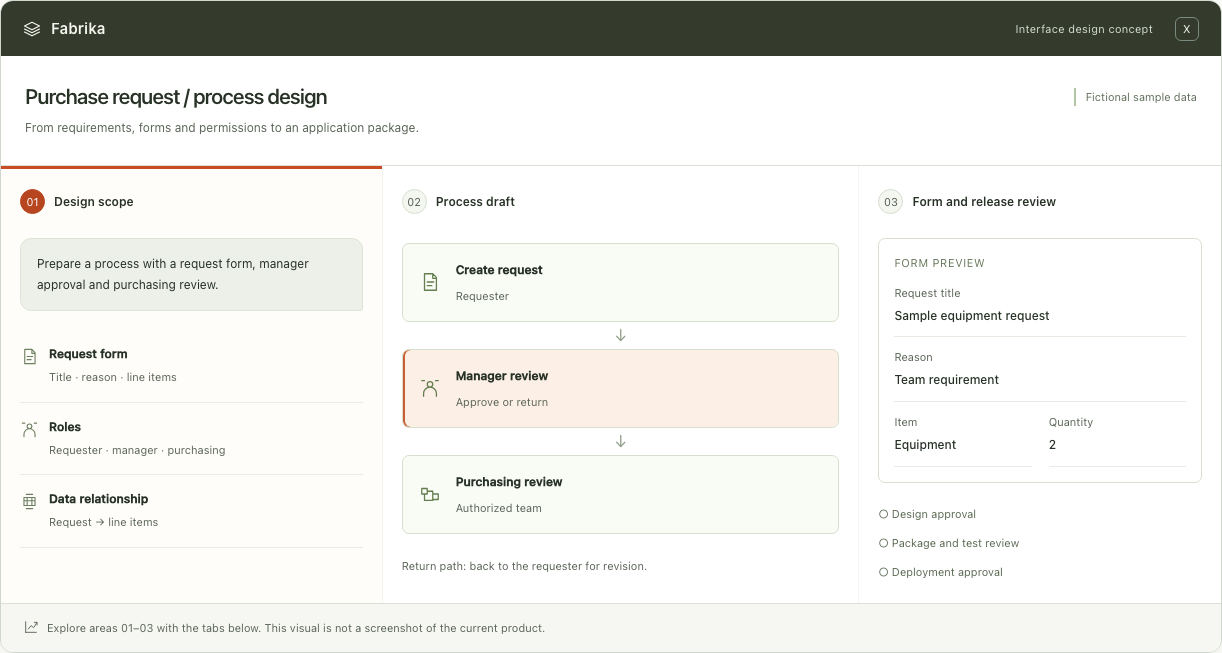
An enterprise BPM core for process steps, forms, roles, tasks, document generation and reporting. Organization-specific workflows and integrations are configured around business needs.
Selected use cases, source information and operational outputs.
Clear ownership and transition rules
The process engine manages tasks and step transitions.
AkışScenario / 01
Interface conceptSchematic example
Process ownership
Domain knowledgeForm record
↓
DesignTask step
↓
ExecutionRole and delegation
↓
EvaluationApproval transition
↳
Decision boundary
Step permissions and process approvals
Process definition, forms and organization roles
OutputTask, document and application records
Documents and reports within the process
Business records connect to document generation, email, export and reporting.
AkışScenario / 02
Interface conceptSchematic example
Work record contents
01Document
02Report
03Email
04Export
Decision boundary
Step permissions and process approvals
Process definition, forms and organization roles
OutputTask, document and application records
Working within the BPM ecosystem
Akış describes the function of the BPM core used here.
AkışScenario / 03
Interface conceptSchematic example
BPM ecosystem
Organization boundary
Licensed core
Organization process
Access and ownership
Integration
Application scope
Decision boundary
Step permissions and process approvals
Process definition, forms and organization roles
OutputTask, document and application records
Application approach
Scope and operating approach.
The scope, operating approach and boundaries of this work.
01
Clear ownership and transition rules
+
The process engine manages tasks and step transitions. Forms, required fields, roles and delegation define what a user can do.
02
Documents and reports within the process
+
Business records connect to document generation, email, export and reporting. APIs and existing integration components connect enterprise applications.
03
Working within the BPM ecosystem
+
Akış describes the function of the BPM core used here. The core source carries a BPM Software AS license; organization-specific process and integration development is scoped separately.
In everyday work
Making the next step clear
Tracking forms, documents and tasks separately obscures where work is waiting. Akış describes BPM infrastructure connecting business records with steps, roles and transition rules.
Akış / Working modelIllustrative use · no real customer data
Tasks and transitions revolve around a shared record. Document generation, email and reporting remain part of the process.
OutputTask, document and application records
Task queue
Clear ownership and transition rules
This component shows incoming information together with its identity and provenance. Process definitions, form fields and organization roles are configured together. Required information and delegation rules determine permitted actions.
Process record
Documents and reports within the process
This component explains how records are reviewed rather than displaying a result in isolation. Tasks and transitions revolve around a shared record. Document generation, email and reporting remain part of the process.
Permissions and transitions
Working within the BPM ecosystem
This component distinguishes the user’s decision from the next work record. APIs and existing connectors link business applications. Licensing for the BPM core is considered separately from organization-specific delivery.
The whole operation
Information, decisions and outcomes stay connected.
These distinctions show the information the application receives, where it needs the user and what it leaves for the next operation.
Starting information
Process definition, forms and organization roles
Human decision
Step permissions and process approvals
Resulting structure
Task, document and application records
How do we assess its impact?
These are evaluation dimensions, not measured performance results. Comparisons use the same task types, data scope and human-review conditions.

 Interface conceptProduct development
