
 Interface conceptPlanning
Visual quality control
Gözcü
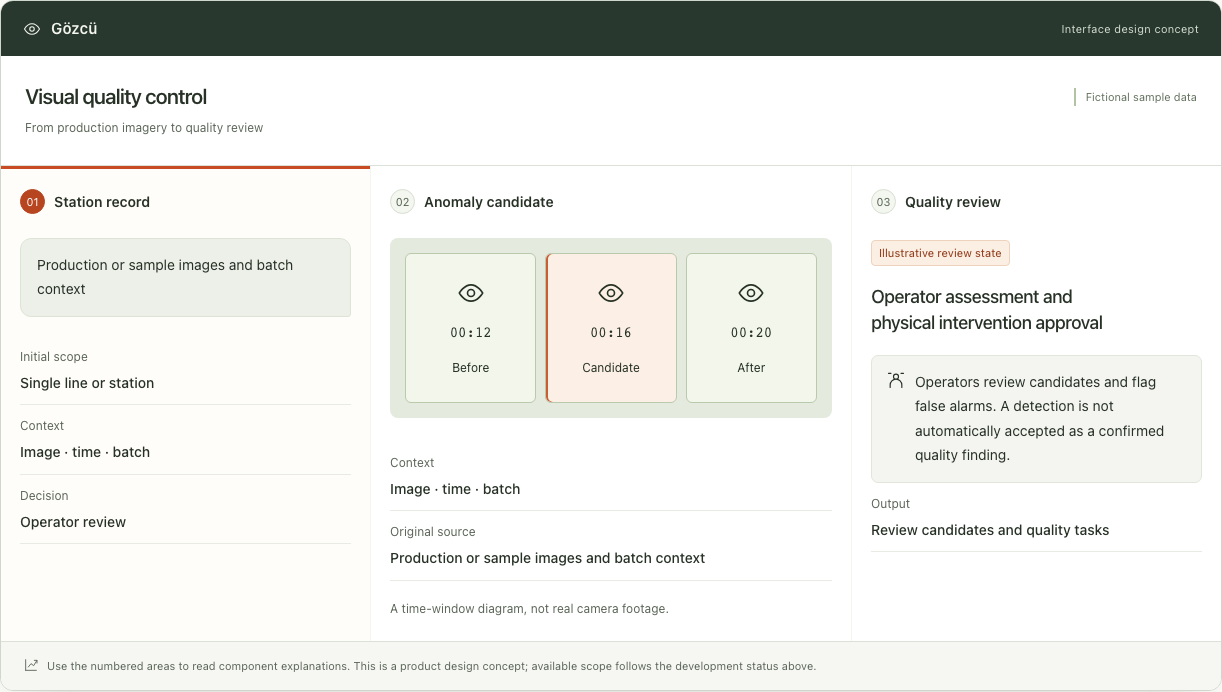
Planned visual quality inspection for production lines. Connects anomaly candidates with station, batch and image context for operator review and corrective work.
Explore the applicationImage and video review
Research into visual evidence for expert review. Connects event candidates to source footage, timestamps, surrounding context and reviewer decisions.
Inside the application
Selected use cases, source information and operational outputs.
The aim is to find relevant intervals in long recordings and retain original timestamps.
Auditor acceptance, rejection or correction
The source device, footage before and after the event, and the applied rule are collected together.
Surrounding context
Review note
Auditor acceptance, rejection or correction
Reviewers accept, reject or reclassify candidates.
Auditor acceptance, rejection or correction
Application approach
The scope, operating approach and boundaries of this work.
The aim is to find relevant intervals in long recordings and retain original timestamps. Candidate events support reviewer preparation.
The source device, footage before and after the event, and the applied rule are collected together. Findings can be reviewed in context.
Reviewers accept, reject or reclassify candidates. Model suggestions and human decisions are stored separately. This is a shared visual-audit research approach.
Research scope: application behavior and business outcomes require pilot validation.
In everyday work
Finding a moment in a long video and deciding what it means are different tasks. Kanıt explores preparing event candidates with original footage and surrounding time context.
Reviewing an event in context
A time-window diagram, not real camera footage.
Reviewers examine what happened before and after. An interpretation from one frame is not presented as a definitive account of the whole event.
This component shows incoming information together with its identity and provenance. Relevant segments are investigated against an event definition. The source device and original timestamp remain with the footage.
This component explains how records are reviewed rather than displaying a result in isolation. Reviewers examine what happened before and after. An interpretation from one frame is not presented as a definitive account of the whole event.
This component distinguishes the user’s decision from the next work record. Acceptance, rejection and reclassification are recorded separately from the model suggestion. Evidence packages preserve the basis for human judgment; this remains research.
The whole operation
These distinctions show the information the application receives, where it needs the user and what it leaves for the next operation.
These are evaluation dimensions, not measured performance results. Comparisons use the same task types, data scope and human-review conditions.
Related work
Interface conceptPlanningVisual quality control
Planned visual quality inspection for production lines. Connects anomaly candidates with station, batch and image context for operator review and corrective work.
Explore the application Interface conceptPlanning
Site safety
Planned site-safety event review using camera footage and defined area policies. Human judgment and privacy are part of the design; the work remains pre-pilot.
Explore the application Interface conceptPlanning
Audit preparation
Planned support for audit preparation. Links requirements to document evidence and routes reviewed findings into corrective tasks and audit records.
Explore the applicationWork with us
Let’s assess your operations, data landscape and priorities together.