
 Interface conceptResearch area
Image and video review
Kanıt
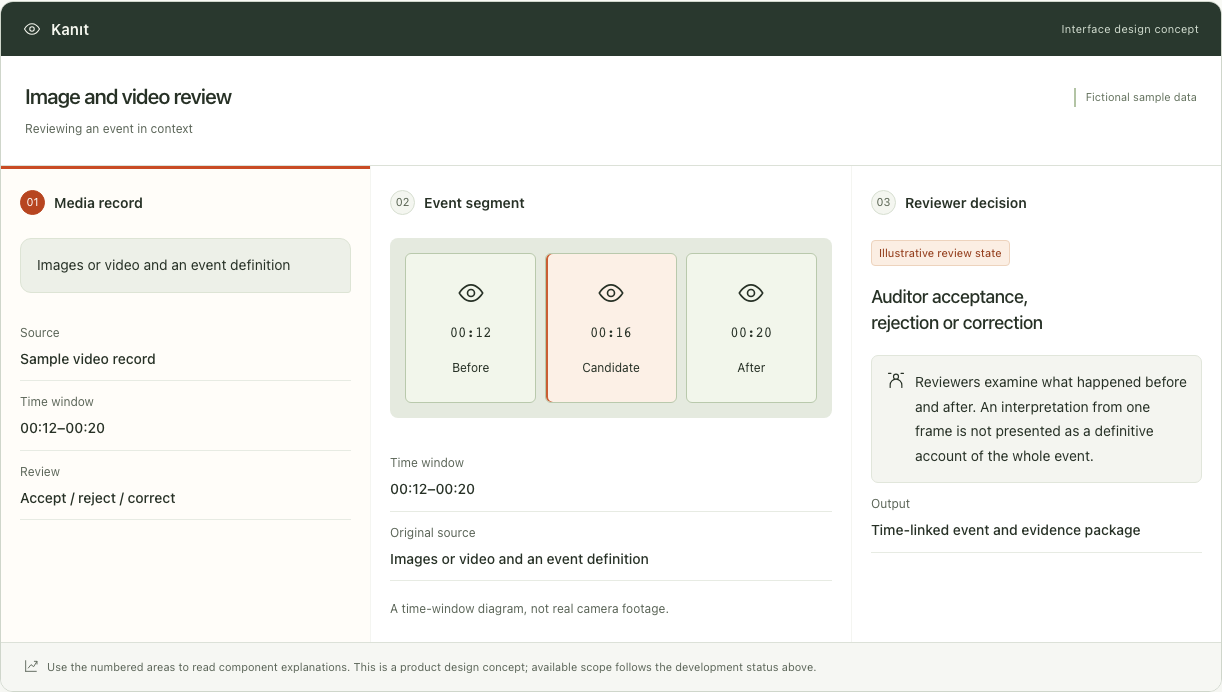
Research into visual evidence for expert review. Connects event candidates to source footage, timestamps, surrounding context and reviewer decisions.
Explore the applicationVisual quality control
Planned visual quality inspection for production lines. Connects anomaly candidates with station, batch and image context for operator review and corrective work.
Inside the application
Selected use cases, source information and operational outputs.
Anomaly detection from sound-product examples and noise filtering are planned.
Operator assessment and physical intervention approval
Operators mark false alarms; accepted events can become alerts, batch flags or nonconformity records.
Operator assessment and physical intervention approval
The initial plan covers one line or station and an operator queue.
Dimensions to evaluate
No result dataShows comparison criteria. Numerical charts require verified data and a defined method.
Operator assessment and physical intervention approval
Application approach
The scope, operating approach and boundaries of this work.
Anomaly detection from sound-product examples and noise filtering are planned. Findings are assessed with image, time, station and batch context.
Operators mark false alarms; accepted events can become alerts, batch flags or nonconformity records. High-impact physical intervention requires human approval.
The initial plan covers one line or station and an operator queue. Multiple lines, deeper PLC integration and assembly verification are later research areas.
Research scope: application behavior and business outcomes require pilot validation.
In everyday work
Not every visual difference is a defect. Gözcü plans to bring anomaly candidates from one line or station to operators with batch and production context.
From production imagery to quality review
A time-window diagram, not real camera footage.
Operators review candidates and flag false alarms. A detection is not automatically accepted as a confirmed quality finding.
This component shows incoming information together with its identity and provenance. Line or sample images are considered against known-good examples. Time, station and batch supply the operational context.
This component explains how records are reviewed rather than displaying a result in isolation. Operators review candidates and flag false alarms. A detection is not automatically accepted as a confirmed quality finding.
This component distinguishes the user’s decision from the next work record. Accepted events are intended to link to quality tasks or nonconformity records. Physical intervention requires human judgment; multi-line scaling and deep PLC integration sit beyond the initial pilot.
The whole operation
These distinctions show the information the application receives, where it needs the user and what it leaves for the next operation.
These are evaluation dimensions, not measured performance results. Comparisons use the same task types, data scope and human-review conditions.
Related work
Interface conceptResearch areaImage and video review
Research into visual evidence for expert review. Connects event candidates to source footage, timestamps, surrounding context and reviewer decisions.
Explore the application Interface conceptPlanning
Site safety
Planned site-safety event review using camera footage and defined area policies. Human judgment and privacy are part of the design; the work remains pre-pilot.
Explore the application Interface conceptPlanning
Audit preparation
Planned support for audit preparation. Links requirements to document evidence and routes reviewed findings into corrective tasks and audit records.
Explore the applicationWork with us
Let’s assess your operations, data landscape and priorities together.