
 Interface conceptResearch area
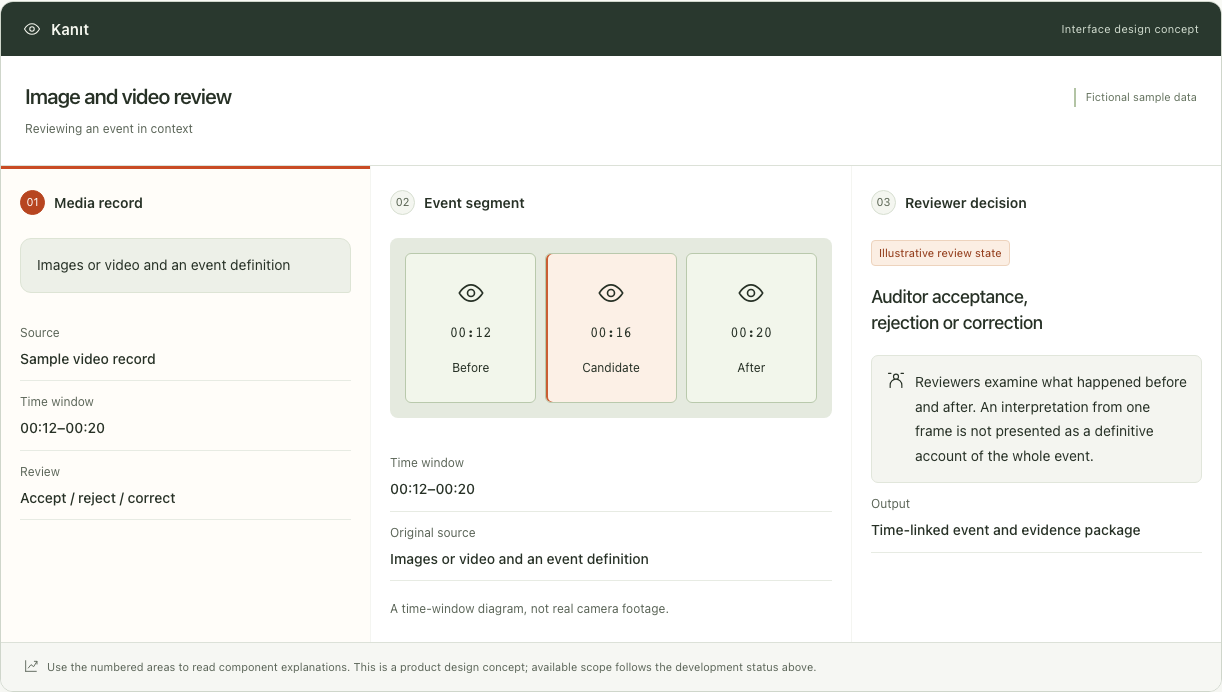
Image and video review
Kanıt
Research into visual evidence for expert review. Connects event candidates to source footage, timestamps, surrounding context and reviewer decisions.
Explore the applicationSite safety
Planned site-safety event review using camera footage and defined area policies. Human judgment and privacy are part of the design; the work remains pre-pilot.
Inside the application
Selected use cases, source information and operational outputs.
The initial scope covers limited event types such as helmets, vests and hazardous zones.
Site supervisor event decision
Combining repeated detections and marking false alarms are planned.
Event candidate
Time and source
Authorized review
Decision record
Site supervisor event decision
The plan prioritizes face blurring and avoids identifying people.
Site supervisor event decision
Application approach
The scope, operating approach and boundaries of this work.
The initial scope covers limited event types such as helmets, vests and hazardous zones. Camera zones and shift policies provide context.
Combining repeated detections and marking false alarms are planned. Site staff assess events; official and disciplinary decisions remain human responsibilities.
The plan prioritizes face blurring and avoids identifying people. The work is pre-pilot; scope needs testing against camera conditions and site requirements.
Research scope: application behavior and business outcomes require pilot validation.
In everyday work
Camera detections cannot be interpreted independently of site rules. Siper places zones, shifts and protective-equipment policies in the context of event review.
Site-specific rules, evidence-based decisions
A time-window diagram, not real camera footage.
Merging repeated candidates and flagging false alarms are planned. The site supervisor reviews footage alongside the applicable rule.
This component shows incoming information together with its identity and provenance. Existing cameras and a limited event set are considered for the pilot. Helmet, vest or restricted-zone rules are defined for the relevant site conditions.
This component explains how records are reviewed rather than displaying a result in isolation. Merging repeated candidates and flagging false alarms are planned. The site supervisor reviews footage alongside the applicable rule.
This component distinguishes the user’s decision from the next work record. An event record is not automatic personnel scoring or a disciplinary decision. The plan prioritizes face blurring and no identity recognition; scope needs validation under real camera conditions.
The whole operation
These distinctions show the information the application receives, where it needs the user and what it leaves for the next operation.
These are evaluation dimensions, not measured performance results. Comparisons use the same task types, data scope and human-review conditions.
Related work
Interface conceptResearch areaImage and video review
Research into visual evidence for expert review. Connects event candidates to source footage, timestamps, surrounding context and reviewer decisions.
Explore the application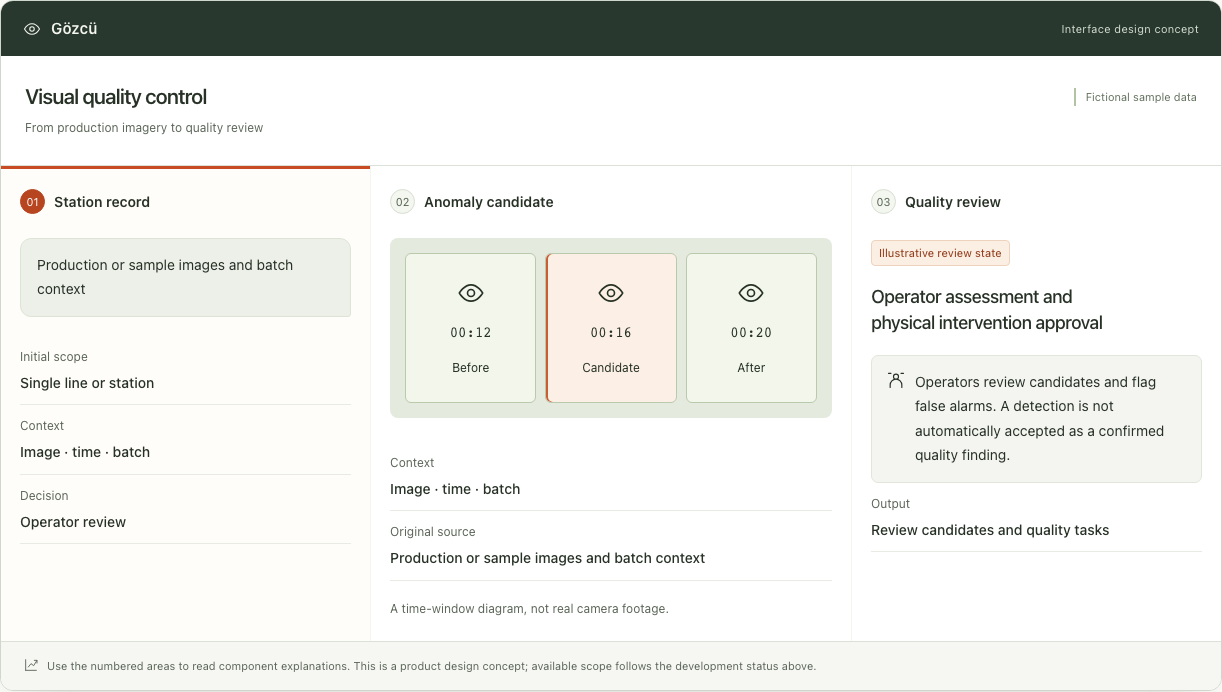 Interface conceptPlanning
Visual quality control
Planned visual quality inspection for production lines. Connects anomaly candidates with station, batch and image context for operator review and corrective work.
Explore the application Interface conceptJoint research
Agriculture and field data
Research into traceable field data for soil, water and environmental workflows. Preserves location, method, source and validation context for specialist assessment.
Explore the applicationWork with us
Let’s assess your operations, data landscape and priorities together.